Acoustic Drywall in Toronto, ON - SONOpan Party Walls, Resilient Channel Ceilings & Soundproofing Installation
GTA Drywall Specialists

Acoustic Drywall in Toronto, ON - SONOpan Party Walls, Resilient Channel Ceilings & Soundproofing Installation

Toronto Drywall Pro designs and installs acoustic drywall assemblies that measurably reduce sound transmission between rooms, suites, and floors. We build to specific STC and IIC targets using Sonopan impact-barrier panels, QuietRock 525 damped drywall, and resilient channel decoupling - matched to what the space actually needs, not a generic "soundproof drywall" upsell that underdelivers once the project is complete.

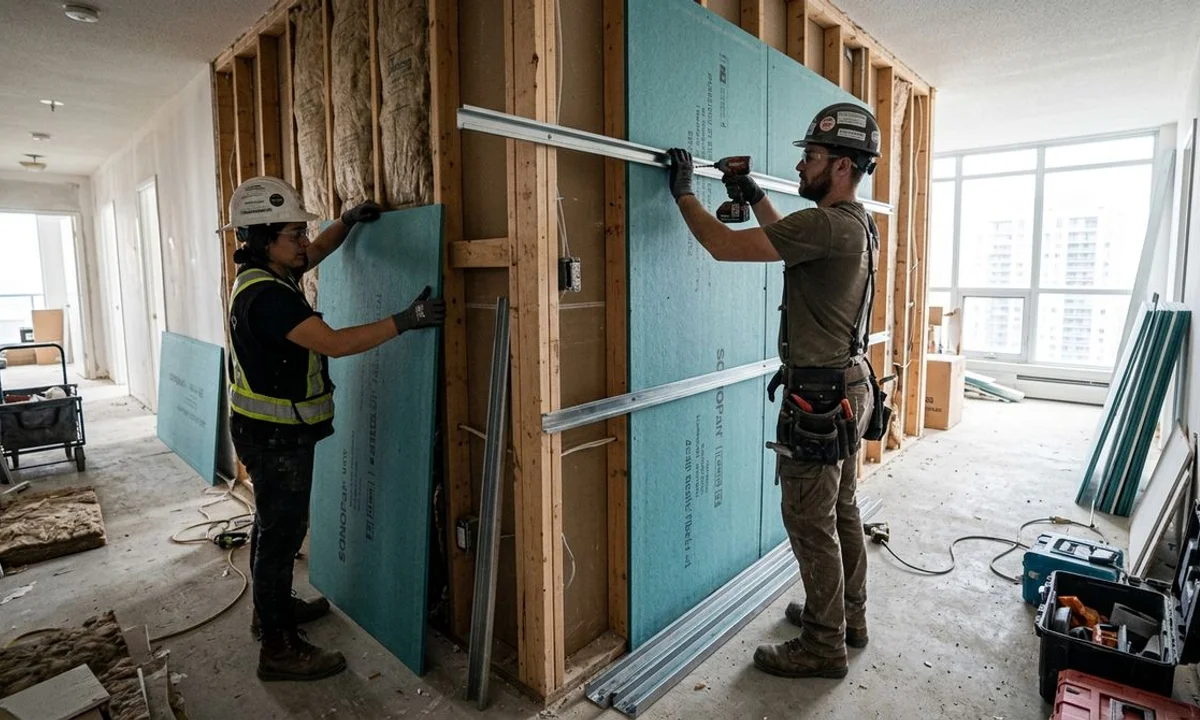
Every acoustic assembly starts with a transmission-loss calculation based on the noise source, frequency range, and wall or ceiling cavity. We install resilient channel on 24-inch centres, pack cavities with Rockwool Safe'n'Sound insulation, and apply double-layer drywall with staggered seams and acoustical caulk at all perimeter joints. Penetrations - outlets, light boxes, pipes - are isolated and sealed individually so the assembly performs as designed rather than bleeding sound at every gap.

Licensed & bonded · WSIB compliant · Same-week scheduling

22+
Years in Business
2,000+
Projects Completed
4.9 ★★★★★
(127 Reviews)
$2M
Liability Insurance
Common Problems

Why Toronto Homeowners Call Us for Acoustic / Soundproof

Sound travels through walls in ways that surprise most clients. These are the gaps in standard drywall that let it through - and the specific assembly details that actually stop it.

01

STC ratings that don't match real-world noise reduction

A product rated at STC 55 only performs at that rating when installed correctly. Resilient channels short-circuited by a screw through the drywall can lose 10-15 STC points.

02

Neighbour noise bleeding through a Toronto condo party wall

Condo party walls often meet the Ontario Building Code minimum of STC 50, but that allows normal conversation and TV to be audible. A real-world quiet wall needs STC 55-60.

03

Not knowing what assembly the condo board will approve

Toronto condo boards vary widely on what acoustic work they'll permit. Getting a crew started without board approval leads to costly stop-work orders.

04

Paying for acoustic products that weren't installed correctly

SONOpan, QuietRock, and Resilient Channel cost significantly more than standard assemblies. Incorrect installation wastes that investment and leaves the noise problem unsolved.

Soundproofing for Toronto Condos, Studios, and Commercial Spaces

Toronto condo living, home recording studios, and shared commercial walls all benefit from a properly engineered soundproof assembly. We install STC-rated systems combining double-layer drywall, decoupling channels, sound-attenuation batts, and acoustic-rated boards like SONOpan and QuietRock.

Most condo retrofits target STC 50 to 60+ on a party wall and 55+ on a ceiling. We’ll walk through what your current assembly likely scores, what each upgrade buys you in decibels, and what stays within Toronto condo board approval rules.

Common Acoustic Drywall Costs in Toronto (2026)

  • Retrofit acoustic upgrade (SONOpan plus new drywall layer): $5 to $8 per square foot
  • Full tear-out with Resilient Channel and double-layer drywall: $8 to $12 per square foot
  • Studio-grade decoupled assembly (STC 65 plus): $10 to $15 per square foot
  • SONOpan acoustic panel material cost: Roughly $35 to $50 per 4 by 8 panel
  • QuietRock constrained-layer drywall material cost: Roughly $80 to $130 per panel
  • Sound Attenuation Batts (mineral wool): Included in most acoustic assembly quotes
  • Condo board approval coordination: Included with every condo retrofit quote

A typical 200 square foot condo party wall retrofit lands between $1,000 and $1,600 for a SONOpan-and-new-drywall upgrade, or $1,600 and $2,400 for a full tear-out with Resilient Channel.

How STC Ratings Translate to Real-World Sound

STC 50. Ontario Building Code minimum at party walls. Loud speech is still audible through the wall; normal speech is muffled. Most builder-standard condo walls.

STC 55. Noticeable improvement. Normal speech is no longer intelligible. TV at moderate volume is muffled but still audible.

STC 60. Loud speech rarely audible. TV and music at normal volume are largely blocked. This is what most condo retrofit clients are aiming for.

STC 65 plus. Loud music is muffled. Drums and bass are partially audible but reduced. Studio-grade.

STC 70 plus. Specialty studio and broadcast applications. Decoupled construction, mass-loaded vinyl, multiple drywall layers.

What Each Acoustic Upgrade Does

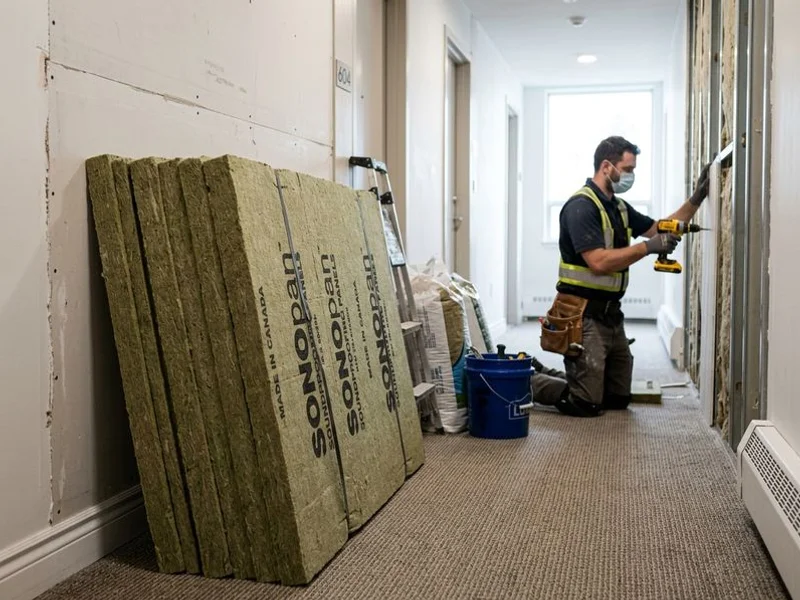
SONOpan. A wood-fiber acoustic panel applied between the existing drywall and a new drywall layer. Adds about 6 to 8 STC points in a typical retrofit. Cost-effective and easy to add in a condo retrofit because you’re not tearing out the existing wall.

QuietRock. Constrained-layer drywall with internal viscoelastic damping. Replaces a standard drywall layer and adds 8 to 12 STC points compared to standard drywall in the same configuration.

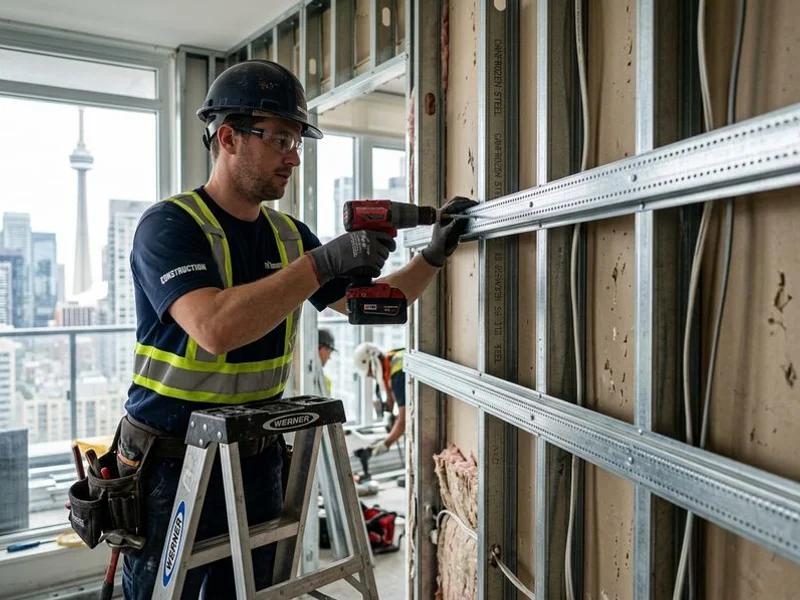
Resilient Channel (RC-1). Decoupling channel that mounts drywall away from the studs, breaking the direct sound path through framing. Adds significant STC improvement (often 10 plus points) but requires the wall to come down to studs.

Sound Attenuation Batts (SAB). Mineral wool batts inside the wall cavity. Modest STC improvement on their own (3 to 5 points), but they’re the cheap insurance every assembly should include.

Decoupled stud walls. Two separate stud walls with a gap between them, no rigid connection. Studio-grade STC, but requires more wall thickness than most condos can afford.
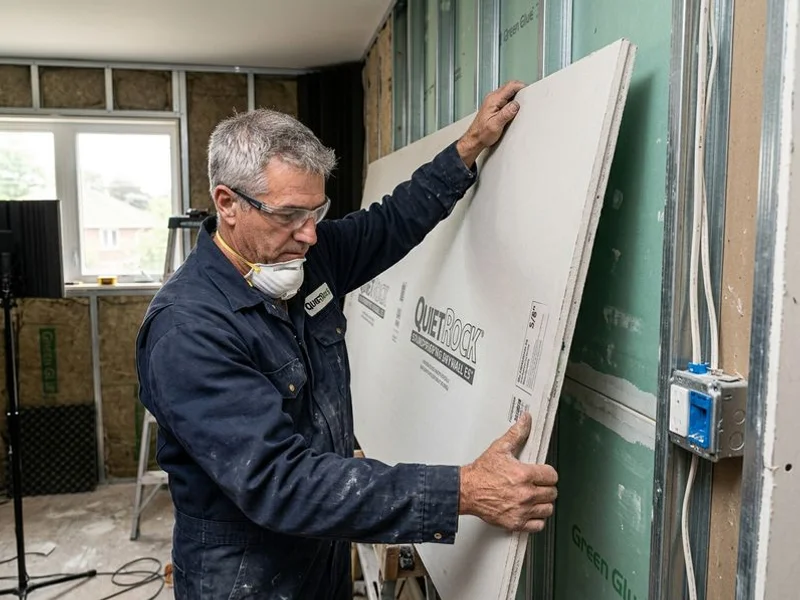
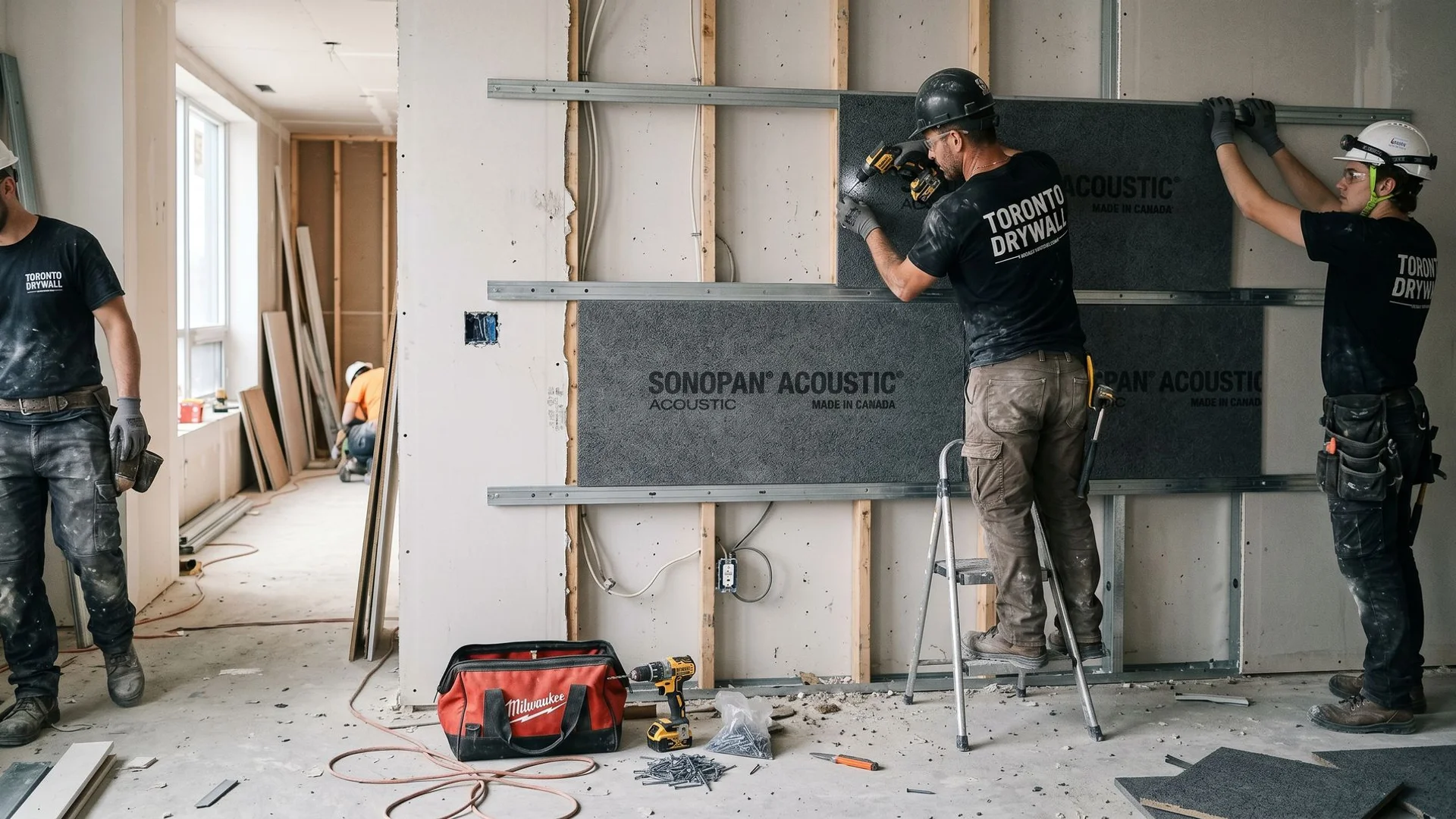
SONOpan acoustic panel and resilient channel being installed for soundproof retrofit on Toronto condo party wall

Retrofit vs Full Tear-Out

Most Toronto condo soundproofing jobs are retrofit work, adding mass and decoupling on top of an existing wall rather than tearing back to studs. Retrofit pros: cheaper, faster, less condo-board friction, fewer permit issues. Retrofit con: you can’t add resilient channel without coming down to studs, so the STC ceiling is around STC 60.

Full tear-out is the right call when:

  • Existing wall is already failing (cracks, deteriorating drywall, water damage history)
  • Target STC is above 60
  • The condo board has approved a full demo (rare but possible)

Condo Board Approval

Most Toronto condo boards approve interior wall acoustic upgrades, especially when there’s a documented noise complaint from a neighbor. We coordinate on:

  • Work permit (board-level approval before mobilization)
  • Building rules (elevator booking, parking, noise windows, dust containment)
  • Assembly documentation (board often wants the spec for record)

We’ve completed acoustic retrofits in downtown Toronto towers, Etobicoke Humber Bay buildings, North York Yonge-corridor condos, and Mississauga Hurontario condos.

Where We Install Acoustic Drywall

Across the Greater Toronto Area with condo retrofit volume concentrated in downtown Toronto, Etobicoke, North York, and Mississauga.

What Is Acoustic Drywall?

Acoustic drywall is a sound-dampening wall or ceiling system that uses mass-loaded gypsum panels, resilient mounting channels, and acoustic sealant to reduce airborne noise transmission between spaces. It differs from standard drywall in that it is engineered to achieve a measurable Sound Transmission Class (STC) rating, which describes how well the assembly blocks sound. STC 50 is the Ontario Building Code minimum between dwelling units. STC 55 to 65 is what most homeowners actually need to eliminate noticeable noise from neighbours, home studios, or mechanical rooms. The system works by adding mass, decoupling the surface from the framing, and sealing every penetration against sound flanking.

What Does Acoustic Drywall Include?

  • Resilient Channel RC-1 or hat channel mounted to studs or joists before panel hang
  • Staggered-stud or double-stud framing for higher-performance assemblies targeting STC 60+
  • SONOpan acoustic wood-fibre panels or QuietRock constrained-layer gypsum in single or double-layer configuration
  • Sound Attenuation Batts (SAB) in all wall and ceiling cavities
  • Acoustic sealant at all perimeter gaps, outlet boxes, and penetrations to prevent flanking
  • Standard tape, mud, and Level 4 finish over the completed assembly

How Much Does Acoustic Drywall Cost in Toronto?

Acoustic drywall in Toronto runs $5 to $12 per square foot installed depending on the STC target and assembly type. A retrofit-over-existing upgrade with SONOpan plus new drywall runs $5 to $8 per square foot. A full tear-out and rebuild with Resilient Channel and QuietRock runs $8 to $12 per square foot. Home studio builds with double-stud framing run higher. Free on-site estimate with STC recommendation included.

Who Needs Acoustic Drywall Installation?

Condo owners dealing with impact noise from upstairs neighbours in Toronto high-rises. Homeowners finishing a basement suite who need sound separation between floors. Music producers and content creators who need a quiet home studio. Commercial tenants fitting out offices where speech privacy between rooms is required.
Real Work

Acoustic Drywall Ceiling Systems: Recent GTA Projects

A look at projects we've recently completed across the Greater Toronto Area.

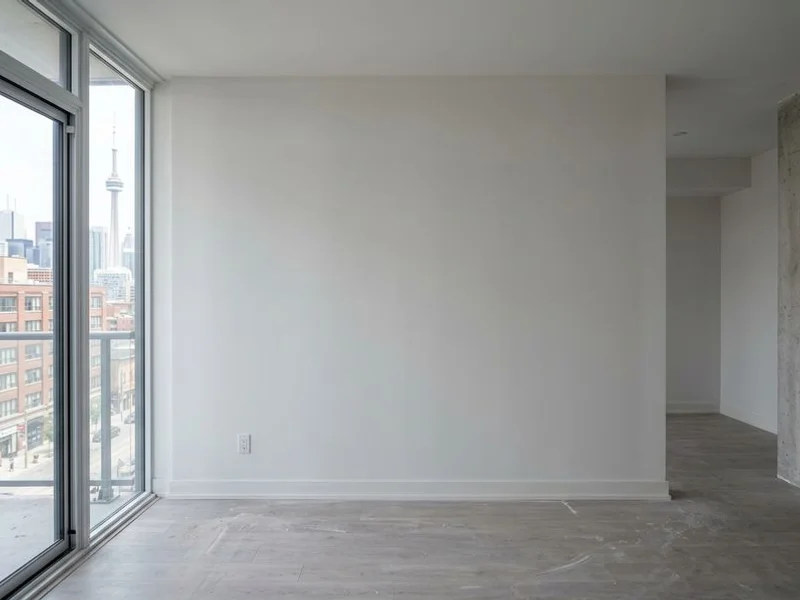
Acoustic Drywall Ceiling Systems project example 1
Recent Project
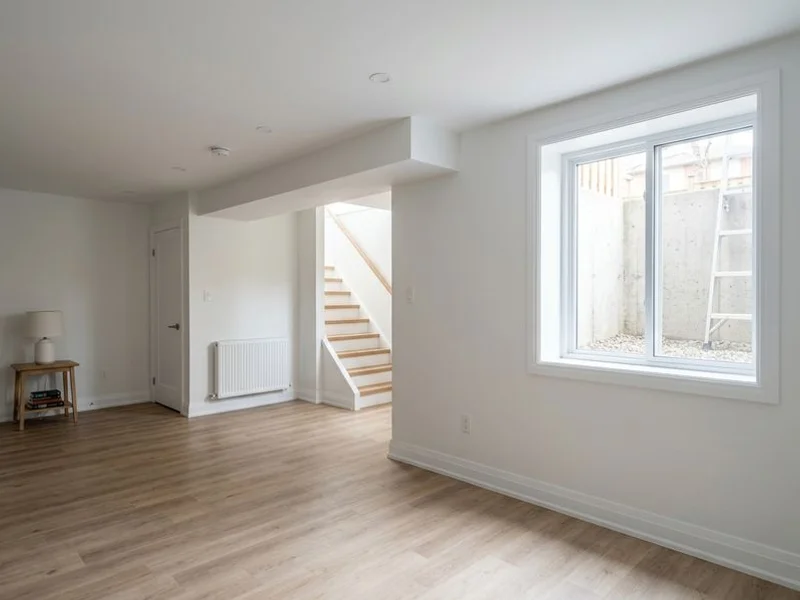
Acoustic Drywall Ceiling Systems project example 2
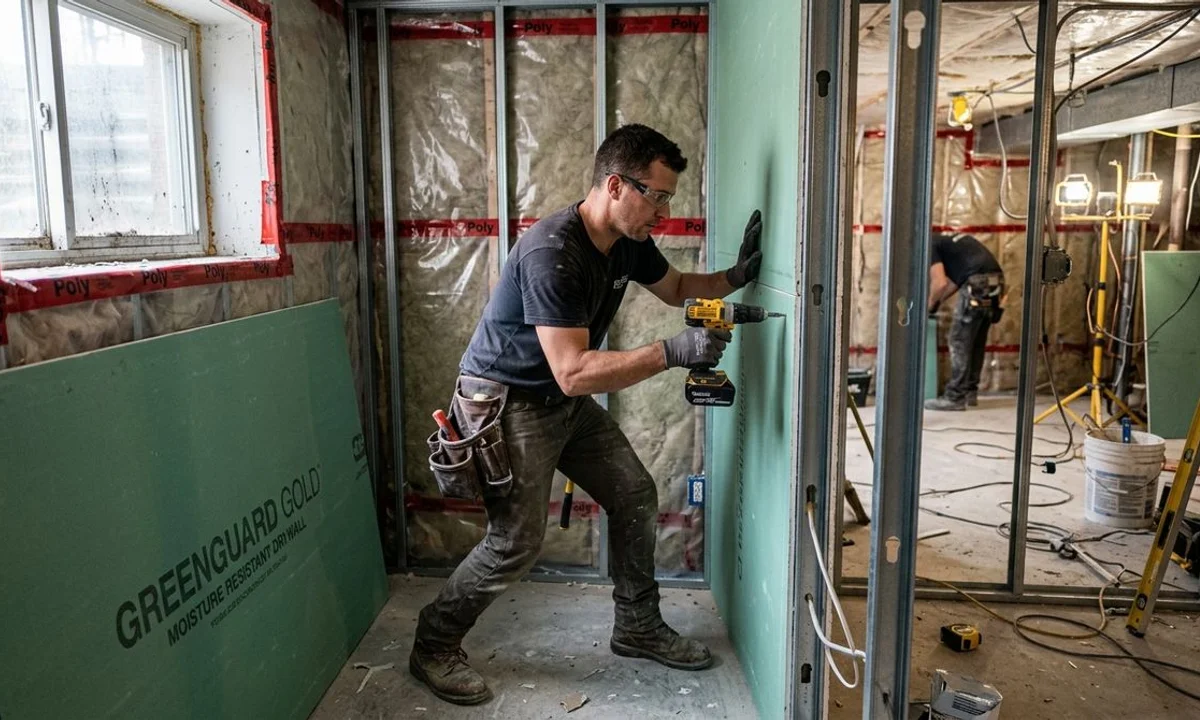
Acoustic Drywall Ceiling Systems project example 3
Acoustic Drywall Ceiling Systems project example 4
Why Choose Us

Why GTA Homeowners Pick Toronto Drywall Pro

Two decades of GTA drywall work answering one homeowner question: what makes a drywall job actually last? Here's what we've built around.

Single-Crew Workflow

Framing, hanging, taping, sanding, and finishing all run by our in-house crew. No subcontractor handoffs, no finger-pointing.

Dustless HEPA Process

99.97% airborne particle capture during sanding and popcorn-ceiling removal. You can stay in the home while we work.

Level 4 & Level 5 Finishing

Standard Level 4 paint-ready, or full Level 5 skim coat for raked-light walls and gloss-paint accent applications.

Licensed, Bonded, $2M Insured

Fully WSIB-compliant with $2M general liability. Certificates of insurance available on request for condo boards and PMs.

Ontario Code Specialists

Type X fire-rated assemblies, basement-stair separations, and party walls installed to Ontario Building Code spec.

Transparent Pricing

Free on-site estimate with line-item pricing. No surprise charges. We tell you up front when a patch is enough and when it isn't.

Real Results

What Clients Say About Our Acoustic Drywall Ceiling Systems

4.9 based on 127+ reviews

“The popcorn ceiling removal was unbelievable. They told us their dustless process was the real deal and they weren't kidding - we lived in the house through the whole job and not a speck of plaster on the floor. Smooth ceiling, paint-ready, done in two days.”

Sarah Miller
Etobicoke - dustless popcorn ceiling removal

“Burst pipe behind the kitchen wall on a Saturday. They came out Monday morning, documented everything for our insurance, removed the wet panels, and had it back to paint-ready by Friday. Honestly the easiest part of the whole insurance claim.”

James Davidson
Oakville - water damage ceiling and wall repair

“We had three contractors quote our basement. Toronto Drywall Pro was the only one who showed up with a tape measure, walked the whole space, and explained the difference between Green Board and Purple Board. Final job came in exactly at quote.”

Priya Sharma
Mississauga - full basement drywall finishing
FAQ

Questions About Acoustic Drywall Ceiling Systems

What STC rating do I need for my Toronto condo wall?

Ontario Building Code requires STC 50 minimum at party walls between dwelling units. STC 55 to 60 is a noticeable real-world improvement (covers normal conversation and TV). STC 65 plus is studio-grade and covers loud music, drums, and gaming. We'll match assembly to your noise problem and your budget.

Will my condo board approve soundproofing work?

Most boards approve interior wall acoustic upgrades, especially when the existing wall is meeting noise complaints. We coordinate with property management on the work permit and provide assembly documentation. We've completed acoustic retrofits across downtown Toronto, Etobicoke, and North York condo buildings.

Can you soundproof a home recording studio?

Yes. Home recording studios need STC 60 plus (often higher) and benefit from decoupled assemblies: separate stud walls with no rigid connection, Sound Attenuation Batts in the cavity, double-layer drywall, and mass-loaded vinyl where space allows. We've done several Toronto and Etobicoke home-studio builds.

What's the difference between SONOpan, QuietRock, and Resilient Channel?

SONOpan is a wood-fiber acoustic panel applied between the existing drywall and a new drywall layer, adding 6 to 8 STC points in a retrofit. QuietRock is constrained-layer drywall with internal viscoelastic damping, adding 8 to 12 STC points by replacing a standard drywall layer. Resilient Channel RC-1 is a decoupling channel mounted to studs, breaking the direct sound path through framing (adds 10 plus STC points but requires the wall to come down to studs). The best assemblies combine all three.

How do you handle sound flanking through floors and ceilings?

Flanking is when sound travels around a wall through the floor slab or ceiling structure rather than directly through the wall. We address this by decoupling the wall from the floor and ceiling with acoustic sealant at the track, using resilient channel, and in some cases adding floor and ceiling treatments. A wall with a high STC rating but untreated flanking paths will still transmit noise.

Can you soundproof a home theatre room?

Yes. A home theatre benefits from the same techniques used for recording studios: mass-loaded assemblies, resilient channel decoupling, and full perimeter acoustic sealing. We assess the room, specify the assembly based on your target STC, and quote framing, drywall, and sealing as a single scope.

What is the difference between sound isolation and sound absorption?

Sound isolation prevents sound from passing through a wall into another room. Sound absorption reduces echo and reverberation inside a room. We do sound isolation via drywall assemblies. Acoustic panels and foam for absorption are a different product. Most clients asking about soundproofing need isolation, not absorption.

How long does a soundproofing project take?

A single wall or ceiling soundproofing job in a condo or home typically runs 2 to 3 days: one day framing and resilient channel, one day drywall, and one day tape and finish. Larger scopes with multiple rooms or floor assemblies take longer. We confirm timelines during the estimate.

Do you work in occupied condo units during soundproofing projects?

Yes, with standard dust containment and agreed-upon working hours. We use plastic sheeting barriers, HEPA air scrubbers, and schedule the dusty phases around your availability. For condo buildings, we follow building rules on working hours and elevator use.

Ready to Get Your Acoustic / Soundproof Quote?

Free on-site estimate across the GTA. Same-week scheduling for most projects.